


A fear of radicalism has been a recurrent characteristic of American life and politics. During the 1790s, the Federalists exploited public distrust of aliens who supported France and criticized President Adams. During the 1830s the Know-Nothings vehemently protested that Catholics posed a danger to America’s republican institutions. And following World War I, a Red Scare directed public frustration at radical labor unions, communist sympathizers, and alleged subversives.
“I have in my hand a list of 205 names”
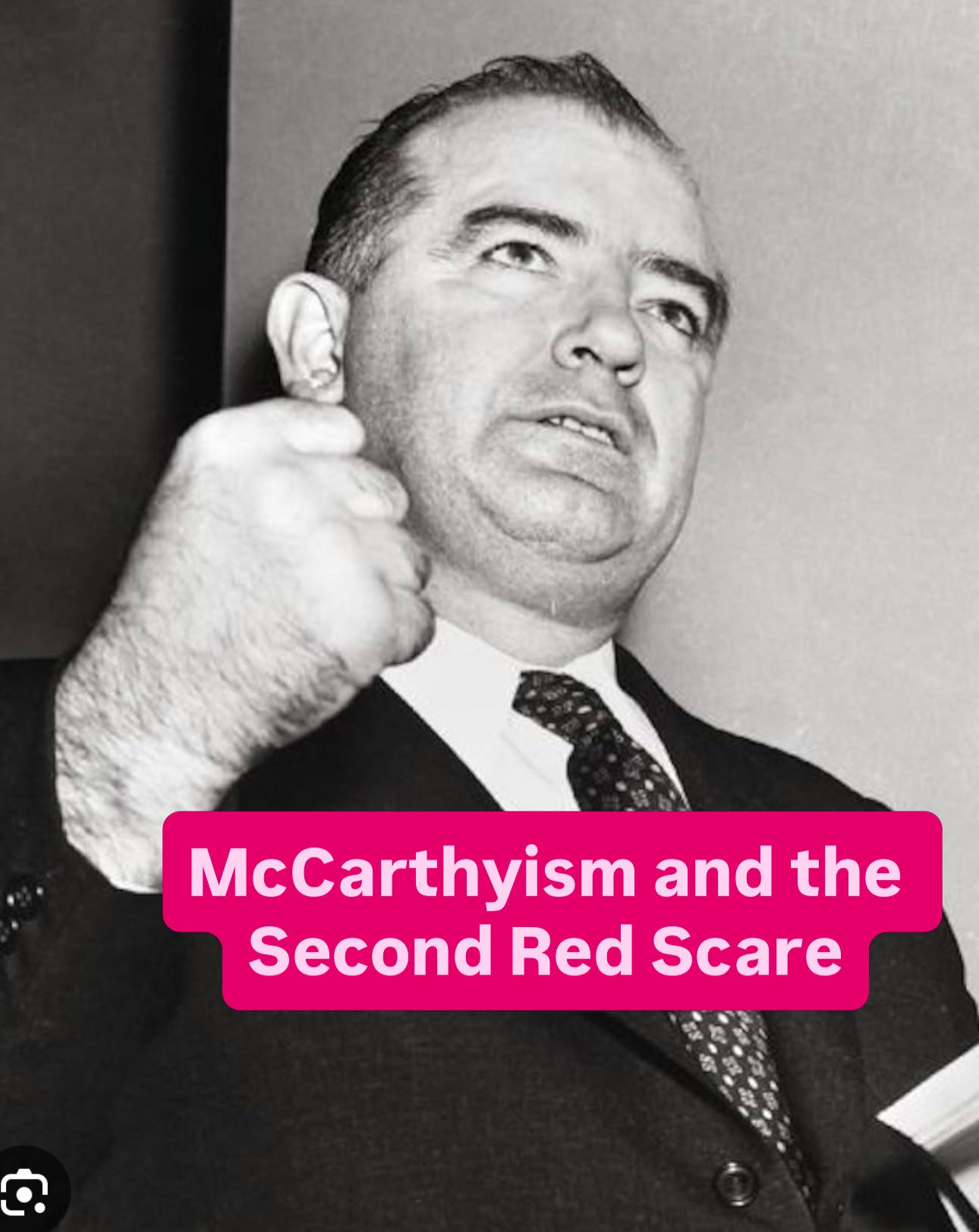
The pattern of fear and anxiety directed at scapegoats erupted again during the early 1950s. On the morning of February 9, 1950, Joseph R. McCarthy was an obscure Republican senator from Wisconsin. But that night everything suddenly changed when McCarthy told an audience in Wheeling, West Virginia, “I have in my hand a list of 205 names known to the Secretary of State as being members of the Communist Party and who nevertheless are still working and shaping the policy of the State Department.” In speeches given the following days, McCarthy repeated his charges but changed the number of names on his list from 205 “security risks” to “57 card-carrying Communists.”
McCarthy’s accusations did not go unnoticed. Although never substantiated, his claims touched a particularly sensitive public nerve. In the four years since the end of World War II, the Soviet Union changed from an ally to a mortal threat to the American way of life. Led by Joseph Stalin, the Soviet Union dominated Eastern Europe, threatened West Berlin, and exploded an atomic bomb. Angry and bewildered Americans demanded to know who was to blame for what had gone wrong.
McCarthyism
Senator McCarthy skillfully exploited the political climate of paranoia. Millions of people listened as McCarthy branded Secretary of State Dean Acheson “the Red Dean” and thundered that America was being sold out by “bright young men who are born with silver spoons in their mouths.” But McCarthyism involved more than just calling people names. Government agencies demanded loyalty oaths and Hollywood studios blacklisted hundreds of actors, screenwriters, directors, and even makeup artists who were suspected of having Communist affiliations.
“What did I do”
McCarthy finally caused his own downfall when he launched a televised investigation of the U.S. Army. McCarthy bullied witnesses, twisted people’s testimony, and used phony evidence. Finally, after he maligned a young lawyer who was not even investigated in the hearings, Army counsel Joseph Welsh turned on McCarthy. His voice rising with controlled indignation, Welsh castigated McCarthy for being “reckless and cruel.” He then pointedly asked McCarthy, “Have you no sense of decency?” Suddenly dumbfounded, McCarthy squirmed in his seat and asked, “What did I do?”
“McCarthyism is McCarthywasm”
The Army-McCarthy hearings swiftly turned public sentiment against McCarthy. In December 1954 the full Senate formally censured McCarthy for his dishonorable conduct. Flashing his famous grin, President Eisenhower asked his cabinet, “Have you heard the latest? McCarthyism is McCarthywasm.”
So why should you remember McCarthyism? You should know that McCarthy’s anti-Communist crusade created a climate of fear and paranoia often called the Second Red Scare. Be prepared to compare the Second Red Scare with the attacks on radicals and immigrants during the First Red Scare. And finally, be prepared to discuss how McCarthyism contributed to growing concerns about national security during the early stages of the Cold War.